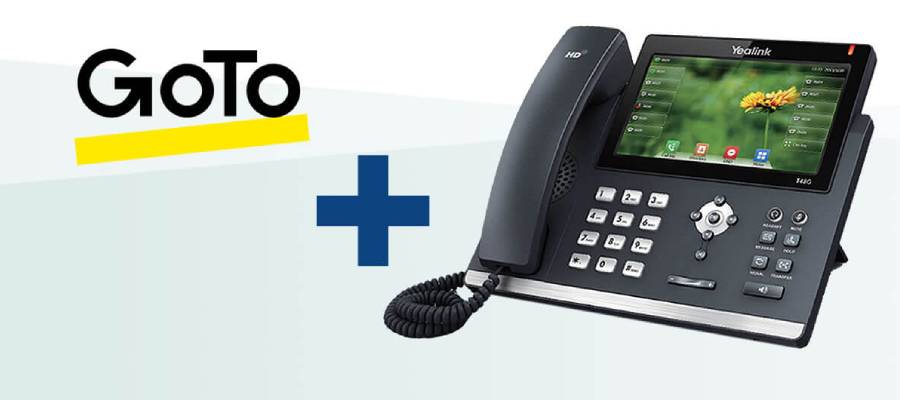
GoTo Connect the Best Cloud Phone Service Providers

Over landlines and on-premise PBX systems, cloud phone systems have many benefits, such as sophisticated call-handling features, cost-effectiveness, and flexible plans.

Here in this article, I have written about the best Cloud Phone service provider with its pricing plan, features, and more. So let’s start with the definition.


GoTo Connect

GoTo Connect is a cloud phone system that combines messaging, voice calling, and video calling into one user interface. Number porting as well as local, toll-free, and vanity numbers are offered.

The best users of GoTo Connect are current GoTo universe users (GoTo Webinar, GoTo Meeting, etc.) who require a business phone system as well as remote or blended smaller teams of up to 25 employees.

Pricing and Plans

Three paid plans are available from GoTo Connect:

  • Basic: $27.00 per user per month.
  • Standard: monthly fees start at $32.00 per user.
  • Premium: monthly fees start at $43.00 per user.

Additional phone numbers can be purchased for $5 per number per month after a 15-day free trial.

What Sets It Apart

The Dial Plan Editor tool is one of the more than 100 call center management features that GoToConnect offers.

The user-friendly call flow management tool enables the configuration of sophisticated call routing, forwarding, waiting, and multi-level IVR strategies. The best part is that GTC provides limitless auto-attendants and submenus, enabling users to create custom self-service menus that will allow agents to focus on other tasks.

Compared to other providers, GTC offers fewer third-party integrations, but it does have a fantastic and active developer community with open-source APIs and SDKs. This permits a great deal of customization.

A recent contacts list, always-on visual notifications, and an intuitive sidebar that allows users to always see all parked calls, recent chat conversations, and favorite contacts are just a few of the features that make it easy to use. No matter the channel, all recent activity is compiled into one interface by its Activity Stream. To-do lists and follow-ups can be kept straightened out even more by allowing users to separate recent activity by channel.

Reliability of the network and customer support

Unfortunately, it’s challenging to find a lot of information about GoTo Connect support and customer service.

According to information on the website as of this writing, GoTo Connect is updating its support center, but the current state of affairs makes it difficult to contact a support agent.

Although there is scant information available, GoTo Connect asserts that its top two plans include 24/7 support via phone, live chat, email, and support ticket generation.

The fact that the most affordable plan only provides a self-service option for customer support is the biggest letdown. Despite the platform’s value, for over $20.00/month per user, this falls far short of expectations. The good news is that the online knowledge base has a strong foundation and includes FAQs, in-depth feature guides, video tutorials, and more. We will keep an eye out for GoTo Connect support announcements and updates.

GoTo Connect has 10 global data centers and a 99.996% uptime in terms of reliability and security to keep things running smoothly. It complies with SOC II Type II, GDPR, CCPA, and HIPAA regulations. Additionally, included are TLS/AES-256 encryption, two-factor authentication, and malware and firewall protection.

What Users Like

Comparing overall costs and value to other cloud phone providers

By adding call center management features a la carte or as a bundle, the top two plans make it simple to transition from a business phone system to a more capable contact center.

High call volumes can be managed more easily thanks to personalized call filtering, dial plan editing, shared voicemail inboxes, and more than 100 other features.

What Users Dislike

The cheapest plan’s support option is self-service only, and the chatbot is unable to provide even the most basic help.


Very few third-party software integrations appear to be intended to encourage users to purchase the entire GoTo suite, even if other business tools would be more appropriate for them.

For Basic and Standard Plans, add-on purchases are necessary for advanced analytics; these purchases can cost up to $29.99 per user per month.

Conclusion

Cloud phone systems have many benefits, such as cost-effectiveness and flexible plans. GoTo Connect combines messaging, voice calling, and video calling into one user interface. GTC offers limitless auto-attendants and self-service menus that will allow agents to focus on other tasks. GoTo Connect has 10 global data centers and a 99.996% uptime in terms of. Reliability and security to keep things running smoothly. The cheapest plan’s support option is self-service only, and the chatbot is unable to provide even the most basic help.

Holoride Launches New Device to Bring VR Entertainment to Any Vehicle

Holoride is a company that offers an in-vehicle virtual reality (VR) experience for passengers in autonomous vehicles. The company was founded in 2018 with the goal of creating immersive, interactive VR content that can be enjoyed during long car rides. The idea behind Holoride is to make the time spent in a car more enjoyable, especially for people who are traveling long distances or who are stuck in traffic. To use Holoride’s VR experience, passengers would need to wear a VR headset and would be able to choose from a variety of VR content, including games, movies, and other interactive experiences.

The startup Holoride, which has the support of Audi, is prepared to introduce its in-car virtual reality entertainment system to the general public.

A device about the size of a smart speaker that can be retrofitted into any vehicle to make it VR ready was unveiled by the company on Wednesday at CES 2023 in Las Vegas. A company that has relied on alliances with automakers for its expansion has reached a turning point with the release of the product.

The in-car VR technology from Holoride is currently only offered in a select group of Audi vehicles from the 2022 model year and later. If customers choose to pay the $799 for the package, this new product would significantly increase its market reach.

The retrofit pack attaches to a vehicle’s windscreen using suction cups and weighs less than half a pound. The hardware comes with a USB-C to USB-A cord that plugs into the car and a lithium-ion battery that operates for 14 hours on a single charge. Two passengers can use holoride at once in the car by connecting up to two headsets at once to the holoride retrofit.

The retrofit hardware, the HTC VIVE Flow headset, a one-year subscription to the holoride platform, and a safety strap are all included in the package. For $199, the holoride retrofit can also be purchased separately.

“The introduction of our holoride retrofit marks the beginning of a new era for holoride. Our goal of providing a manufacturer-neutral entry point into the “Motorverse” has finally been realised, according to Holoride CEO and co-founder Nils Wollny. Every new ride serves as the model for your upcoming immersive adventure in holoride’s adaptive virtual experiences, which are now accessible from any vehicle.

Holoride retrofit operates in a manner akin to its current technology. Bluetooth is used to connect the product to a VR headset. The software from Holoride uses a vehicle’s location and movement data. To avoid motion sickness, the virtual reality content is synced in real time with the movements of the vehicle.

The company also revealed an update to its VR catalogue, which now features games like Cloudbreakers: Leaving Haven from Schell Games and Superconductor, a studio founded by the Russo Brothers, as well as educational apps like Einstein Brain Trainer. According to a report from Holoride, subscribers now have access to the new game Pixel Ripped 1995: On the Road (PEGI7) from the ARVORE studio. A custom web browser and an Android screen mirroring feature are also part of the complete lineup.

Nowatch is a Health-Focused Smartwatch Without the Watch Part

You can’t change what you can’t measure because your health is all that you have, so it should come as no surprise that health trackers are widely available. The issue with many of them, though, is that in addition to tracking your heart rate, steps, and other data, they also send you a barrage of notifications. 

Nowatch adopts a different strategy and provides many of the features you’d anticipate from a health tracker. The company does away with the traditional “tiny smartphone display” approach that AppleGoogle, and Samsung appear to have embraced as well as the more conventional analog watch look from companies like Withings. Instead, it replaces the watch face with a variety of interesting-looking materials.

The business likes to call itself a “wearable,” which reflects its goal to combat overstimulation, anxiety, and stress. Hylke Muntinga, the company’s CEO and co-founder, had a string of bad luck and was also diagnosed with a rare genetic condition, which served as the company’s inspiration.

“You become aware that life and death are so close to one another in those circumstances. Then, two and a half years ago, I discovered that I have a rare disease called PXE, which is causing me to go blind. That served as a reminder to avoid getting sidetracked. Mounting told TechCrunch in an interview at CES in Las Vegas, “I have to live right now.

The business then produced Nowatch. The gadget has no screen; instead, it has stylish, ethically sourced gemstone faces that resemble jewelry. The not-watch has sophisticated health-tracking technology inside that works silently while the wearer goes about their day. With the aid of skin conductance, the device uses Philips EDA (Electrodermal Activity) Biosensing Technology to track changes in sweat gland activity. A small, harmless current is applied to the skin by the biosensing technology, which then tracks how the electrical conductance between two points on the skin changes over time.

“Nowatch is intended for anyone who genuinely wants to embrace science and technology and who prefers to wear beautiful, sustainable clothing. Watches have always been jewelry that declares, “Hey, look at me. We notice that many people are drawn to us because of our aesthetics, Muntinga said.

In order to help the wearer become aware of their stressors and emotional outputs, the wearable can estimate the wearer’s level of stress and send them gentle vibrations. Nowatch attempts to measure and remind by getting to know the wearer’s biorhythms. The watch also analyses your measurements to estimate your “cognitive zones,” or your ability to think clearly, your mood, and your “stress fingerprint.”

“We can anticipate stress up to an hour in advance. We’re attempting to determine how chronic stress affects your habits, and we’re working to assist people in changing their habits or things that have a long-term impact on their habits, says Muntinga.

An iOS or Android app that can display the user’s physiology in real time and provide suggestions and actionable insights for a more balanced life is used to interact with the watch’s readings. Red and green PPG, EDA, an accelerometer, temperature sensors, and a barometer are among the sensors.

The MSRP of the Nowatch starts at $500, and its battery life is up to four days. From the following week, it will be accessible. Additional gems, such as White Agate, Tiger’s Eye, Rose Quartz, Malachite, Lapis Lazuli, Labradorite, Falcon Eye, and Amethysts, can be purchased separately.

Depending on the stone, prices can range from $25 to several hundred dollars, and the team hints that it might be planning some unique collaborations.

“We’re collaborating with some jewelry designers and artists. Limited editions of the Nowatch are currently being created, some of which incorporate moonstones and meteorites. People proclaimed, “I want something completely different,” And there is such a strong demand for it,” says Muntinga. “We’re eager to see which artists we can collaborate with on new projects.”

Predictions For Fintech In 2023

It’s safe to say that we had little idea, at the start of 2022, that the second half of the year would prove to be quite difficult and possibly a turning point for the fintech sector in general.

Since more than ten years ago, low-interest rates have encouraged investment, and traditional venture capitalists (VCs) are now facing competition from hedge funds, sovereign wealth funds, and family offices. Everyone everywhere experienced a fear of missing out.

Due to the exponentially accelerated adoption of digital technology during the COVID-19 pandemic—in fact, what should have taken years to change consumer behavior only took months during this time—investments in fintech startups went into overdrive.

1. Ongoing downsizing of fintech startups This will be especially true for startups that raised money in 2021 and 2022 with a short runway and very high valuations. Many fintech firms will be forced to close their doors or sell themselves, especially those in B2C and working with retail borrowers. Some will accept funding in exchange for significant valuation haircuts, allowing them to extend their runways. However, there is some good news: pre-seed and seed startups, as well as those that are headed toward profitability, are in a better position to raise money (especially from returning fintech founders) and entice top talent from later-stage startups.

2. There will be more opportunities than ever for great talent. And this is particularly true for incumbents and startups in the pre-seed and seed stages. Employees have lost faith and confidence in later-stage startups that have gone through layoff rounds or are expected to do so soon. Because their equity is in the red, all of their top employees will quit. This means that business owners in this sector need to keep an eye out and ensure that they hire the best candidates available. Their knowledge will be incredibly helpful to you.

3. Financial inclusion and environmental, social, and governance (ESG) frameworks will be highlighted Financial inclusion has benefited greatly from the recent strong adoption of fintech, particularly digital wallets (which was accelerated by the COVID-19 pandemic), particularly in the MENA region. More than 100 million people in the MENA region lack access to financial services, and numerous initiatives are being launched by regional central banks, organizations like the United Nations Development Programme, the World Bank, the International Finance Corporation, and others to adopt fintech and promote partnerships with established players in the financial services industry. This bodes well for fintech startups focusing on ESG and financial inclusion.

4. Active mergers and partnerships between established players and fintech firms Banks are restocking their war chests in response to rising interest rates, and given the drastically reduced valuations of fintech startups currently available, they will undoubtedly go on an acquisition binge. They will either pick off their talent as startup employees go back to banks and asset managers or outright buy fintech to hasten their own development. Since JP Morgan was the most active in the fintech sector in 2022, I would also anticipate seeing more partnerships form.
5. Modifications to the cross-border remittance industry Last but not least, as a co-founder of the cross-border remittance startup Purpl, I anticipate that global remittance levels will decline from their peaks following 9% growth in 2021 and 5% growth in 2022 to $626 billion, with a potential contraction of 0-3%. This will primarily be caused by foreign workers in the US, Europe, and MENA losing their jobs as a result of cost-cutting measures or, in the best cases, saving less due to higher living expenses and lower purchasing power, which will ultimately result in them having less money to remit to their families. Having said that, this contraction will present a chance for fintech firms operating in the sector to sharpen their product and service portfolios and user experiences in order to increase their market share of their addressable market.

Design a site like this with WordPress.com
Get started